Andrea Coyle, East Village History Project's Director of Outreach, was recently interviewed by Women's eNews, about her thoughts on The Museum of American Finance's new "Women of Wall Street" exhibit. You can read the rest of the article here:
http://www.womensenews.org/article.cfm/dyn/aid/4111
Monday, August 24, 2009


Saturday, August 1, 2009
LESHP director to participate in panel on East Village
Panelists will include Council Member Rosie Mendez (District 2); Steve Zeitland, Founder and Executive Director of City Lore, Eric Ferrara, Founder and Executive Director of the East Village History Project; and Marguerite Van Cook, Multimedia Artist and Executive Director of the Howl! Festival.
The panel is a part of Metropolitan's East Village Theater Festival, a three-week celebration of the changing culture of the East Village. Combining two of the theater’s annual new works series and featuring the work of local artists and musicians, the festival will be held every day of the week in Metropolitan’s home at 220 E 4th Street August 3rd through 23rd, 2009.
Metropolitan Playhouse Presents
Discussion Panel: The Changing East Village
Monday, August 17, 2009, 8:00pm
Part of the East Village Theater Festival
More info on event and festival: metropolitanplayhouse.org
The panel is a part of Metropolitan's East Village Theater Festival, a three-week celebration of the changing culture of the East Village. Combining two of the theater’s annual new works series and featuring the work of local artists and musicians, the festival will be held every day of the week in Metropolitan’s home at 220 E 4th Street August 3rd through 23rd, 2009.
Metropolitan Playhouse Presents
Discussion Panel: The Changing East Village
Monday, August 17, 2009, 8:00pm
Part of the East Village Theater Festival
More info on event and festival: metropolitanplayhouse.org
Friday, July 31, 2009
EVHP director to participate in panel on East Village
Metropolitan Playhouse Presents
Discussion Panel: The Changing East Village
Monday, August 17, 2009, 8:00pm
Part of the East Village Theater Festival
 Panelists will include Council Member Rosie Mendez (District 2); Steve Zeitland, Founder and Executive Director of City Lore, Eric Ferrara, Founder and Executive Director of the East Village History Project; and Marguerite Van Cook, Multimedia Artist and Executive Director of the Howl! Festival.
The panel is a part of Metropolitan's East Village Theater Festival, a three-week celebration of the changing culture of the East Village. Combining two of the theater’s annual new works series and featuring the work of local artists and musicians, the festival will be held every day of the week in Metropolitan’s home at 220 E 4th Street August 3rd through 23rd, 2009.
More info on event and festival: metropolitanplayhouse.org
Discussion Panel: The Changing East Village
Monday, August 17, 2009, 8:00pm
Part of the East Village Theater Festival
 Panelists will include Council Member Rosie Mendez (District 2); Steve Zeitland, Founder and Executive Director of City Lore, Eric Ferrara, Founder and Executive Director of the East Village History Project; and Marguerite Van Cook, Multimedia Artist and Executive Director of the Howl! Festival.
The panel is a part of Metropolitan's East Village Theater Festival, a three-week celebration of the changing culture of the East Village. Combining two of the theater’s annual new works series and featuring the work of local artists and musicians, the festival will be held every day of the week in Metropolitan’s home at 220 E 4th Street August 3rd through 23rd, 2009.
More info on event and festival: metropolitanplayhouse.org
Tuesday, July 28, 2009
The New Museum Block Party
The East Village History Project (EVHP) team was able to participate in the New Museum Block Party on Sunday, July 26, at Sara D. Roosevelt Park in the Lower East Side.
At our table we provided information about the various walking tours that we offer at the East Village Visitors Center.
Although it was a very hot and sunny day, enthusiasm was high & many people visited our booth and joined our free "Bowery" walking tours, lead by EVHP Executive Director Eric Ferrara.
For those who missed it: the "Bowery" walking tours are usually offered on Thursdays at 2:00 P.M.
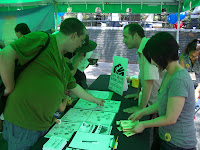 We also had a fantastic time with our visitors by playing our famous "Guess the Great and the Famous of the East Village" game. On 5 panels, we displayed pictures of famous people divided into different categories such as: artists and musicians, anarchists, or gangsters, which were all
in someway significant to the East Village. Those of our visitors who were able to name 5 people on these panels won an "East Village Visitors Center History Bar", a chocolate bar, affectionately designed by Andrea Coyle, Director of Outreach.
Despite the heat and humidity it was loads of fun, and we are thrilled we were able to be apart of it!
At our table we provided information about the various walking tours that we offer at the East Village Visitors Center.
Although it was a very hot and sunny day, enthusiasm was high & many people visited our booth and joined our free "Bowery" walking tours, lead by EVHP Executive Director Eric Ferrara.
For those who missed it: the "Bowery" walking tours are usually offered on Thursdays at 2:00 P.M.
 We also had a fantastic time with our visitors by playing our famous "Guess the Great and the Famous of the East Village" game. On 5 panels, we displayed pictures of famous people divided into different categories such as: artists and musicians, anarchists, or gangsters, which were all
in someway significant to the East Village. Those of our visitors who were able to name 5 people on these panels won an "East Village Visitors Center History Bar", a chocolate bar, affectionately designed by Andrea Coyle, Director of Outreach.
Despite the heat and humidity it was loads of fun, and we are thrilled we were able to be apart of it!
We encourage you to stop by for at least a coffee. Visit our web page for more info about our upcoming events and walking tours.
-Ina & the East Village History Project Team
Thursday, July 16, 2009
EVHP partners with Orenzanz Summer Museum on Governor's Island
East Village History Project is a proud partner of the Orensanz Summer Museum on Governor's Island this Summer 2009.
We encourage art lovers and adventurers to take the 10 minute ferry departing from South Manhattan (or Brooklyn) and make a pleasant promenade to the Island, where you can enjoy the specially curated drawings, light boxes and external sculptures created specifically for the occasion as well as workshops and debates covering a wide range of disciplines.
 The exhibition is open every weekend from June 14th to October 3rd, and together with other cultural activities programmed on the Island, the Orensanz Summer Museum's aim is to make of this tiny island in the heart of New York’s Bay a new cultural reference for the city’s summer artistic scenario.
MORE INFORMATION: http://www.orensanz.org/index.php?option=com_content&task=view&id=95&Itemid=32
We encourage art lovers and adventurers to take the 10 minute ferry departing from South Manhattan (or Brooklyn) and make a pleasant promenade to the Island, where you can enjoy the specially curated drawings, light boxes and external sculptures created specifically for the occasion as well as workshops and debates covering a wide range of disciplines.
 The exhibition is open every weekend from June 14th to October 3rd, and together with other cultural activities programmed on the Island, the Orensanz Summer Museum's aim is to make of this tiny island in the heart of New York’s Bay a new cultural reference for the city’s summer artistic scenario.
MORE INFORMATION: http://www.orensanz.org/index.php?option=com_content&task=view&id=95&Itemid=32
Sunday, July 12, 2009
The story of Thomas "Blind Tom" Wiggins, former slave and musical genius
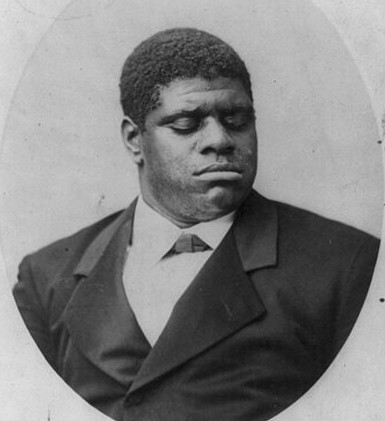 Thomas Greene Wiggins (1849-1908) was a former slave and indentured servant who began playing piano by the age of four and became one of the most celebrated musicians of the Civil War era.
Thomas was born autistic and without sight on May 25, 1849 to Mungo and Charity Wiggins, two Georgia plantation slaves owned by Wiley Edward Jones. His family was sold soon after to Colonel James Neil Bethune, and Tom was "thrown in as a bargain." By all accounts, because of his disabilities, Thomas was treated like a "household pet," but Bethune's daughter Mary recognized talent in the young boy and became his first music teacher. Thomas learned fast and began performing publicly by the age of eight.
By 1858, at the age of nine, Thomas was basically rented out by the Bethune family to Perry Oliver, who booked performances for Thomas all over the South, promoted as the "Musical Prodigy of the Age: a Plantation Negro Boy." Bethune received $15,000 for the three-year contract, which, as a slave, Thomas saw no part of.
Thomas Wiggins continued to astound audiences and performed many high-profile events, including a concert before President James Buchanan in 1859, becoming the first African-American to ever perform at the White House.
In 1864, James Bethune, sensing a Union victory in the Civil War (and an end to slavery), protected his investment by convincing Mingo and Charity to sign an indenture agreement for Tom's services. Under contract, Tom's parents were to receive "a good home and subsistence and $500 a year". Sixteen year old Thomas was promised "$20 per month and two percent of the net proceeds of his services".
Over the next few years, Thomas was touring all over the United States and Europe. He was being managed by John C. Bethune, who was earning as much as $50,000 a year from the performances. It was a rigorous schedule, but Thomas the respect of professional musicians the world over.
John G. Bethune had himself appointed Thomas's legal guardian on July 25, 1870, and soon moved to New York City to live with his new new wife, the owner of the boarding house where they lived (7 St. Marks Place).
Over the following nine years, while living here on St. Marks Place, Thomas Wiggins studied music with Professor Joseph Poznanski, who wrote down and collected many of Thomas' original compositions.
In 1865, a custody battle broke out when Charity Wiggins filed a suit against the Bethunes for the return of her son and a fair share of profits. John Bethune was killed in 1887 while trying to board a local train, but his widow, Eliza, ended up winning the long and bizarre custody battle later that year.
 Thomas' last public appearances were between April 17-22, 1905 in Boston and little was heard from him again until his death at age 59 on June 13, 1908. Thomas Wiggins died of natural causes in the new home of Eliza Bethune in Hoboken, NJ, his memorial was held at the Frank E. Campbell funeral chapel at 241 W.23rd Street.
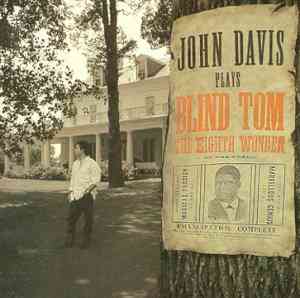
In 1999, the first commercial CD of music composed by Thomas Wiggins was released called John Davis Plays Blind Tom.
Read more about the incredible life of Thomas "Blind Tom" Wiggins here: http://chevalierdesaintgeorges.homestead.com/Wiggins.html
And Here: Blind Tom, the Black Pianist-Composer 1849-1908 By Geneva Handy Southall
Tuesday, June 30, 2009
Local activist awarded prestigious 2009 Jane Jacobs Medal
The Rockfeller Foundation announced today that the recipients of the 2009 Jane Jacobs Medal are Richard Kahan and Damaris Reyes. The medal, which is administered by the Municipal Art Society of New York (MAS), was created in 2007 to honor the author and activist who died in April 2006. It is awarded annually to two New Yorkers whose work creates new ways of seeing and understanding the city.
Founder and CEO of the Urban Assembly, Richard Kahan is a former President of the New York State Urban Development Corporation and former Chairman of the Battery Park City Authority. Since 1999, the Urban Assembly has created, and now manages, 22 public secondary schools located, by design, in many of the lowest income neighborhoods in New York. Mr. Kahan will receive the 2009 Jane Jacobs Medal for Lifetime Leadership.
 Damaris Reyes, Executive Director of Good Old Lower East Side (GOLES), will receive the 2009 Jane Jacobs Medal for New Ideas and Activism. She began her work with GOLES as a grassroots community organizer before assuming her current role in 2005. Through an approach Reyes describes as holistic, GOLES has been pivotal in strengthening the community and preserving the character of the Lower East Side. Both medals come with an award of $100,000.
To read more about the work of the 2009 recipients, click here.
Previous years' recipients include Peggy Shepard, executive director and co-founder of West Harlem Environmental Action, Inc. (WE ACT), and Alexie Torres-Fleming, founder of Youth Ministries for Peace and Justice (YMPJ) in 2008; and Barry Benepe of New York City?s Greenmarket program and Omar Freilla of Greenworker Cooperatives in the Bronx in 2007.
The Rockefeller Foundation made a grant to Jane Jacobs in the 1950s for the research and writing of the book The Life and Death of Great American Cities. More than fifty years later, this work remains one of the most influential books ever written on urban design.
The 2009 Jane Jacobs Medal Jury was chaired by Dr. Judith Rodin, President of the Rockefeller Foundation, and comprised Rockefeller Foundation trustee David Rockefeller, Jr., Dean of New York University's Tisch School for the Arts Mary Schmidt Campbell, and The New Yorker architecture critic Paul Goldberger.
For more information about the award and past year's recipients, visit www.mas.org/jane-jacobs-medal.
------
Congratulations to Damaris for her important work in the community. Visit GOLES: http://www.goles.org
*Recent image of Damaris Reyes and Carlos Garcia courtesy of The Villager
Founder and CEO of the Urban Assembly, Richard Kahan is a former President of the New York State Urban Development Corporation and former Chairman of the Battery Park City Authority. Since 1999, the Urban Assembly has created, and now manages, 22 public secondary schools located, by design, in many of the lowest income neighborhoods in New York. Mr. Kahan will receive the 2009 Jane Jacobs Medal for Lifetime Leadership.

To read more about the work of the 2009 recipients, click here.
Previous years' recipients include Peggy Shepard, executive director and co-founder of West Harlem Environmental Action, Inc. (WE ACT), and Alexie Torres-Fleming, founder of Youth Ministries for Peace and Justice (YMPJ) in 2008; and Barry Benepe of New York City?s Greenmarket program and Omar Freilla of Greenworker Cooperatives in the Bronx in 2007.
The Rockefeller Foundation made a grant to Jane Jacobs in the 1950s for the research and writing of the book The Life and Death of Great American Cities. More than fifty years later, this work remains one of the most influential books ever written on urban design.
The 2009 Jane Jacobs Medal Jury was chaired by Dr. Judith Rodin, President of the Rockefeller Foundation, and comprised Rockefeller Foundation trustee David Rockefeller, Jr., Dean of New York University's Tisch School for the Arts Mary Schmidt Campbell, and The New Yorker architecture critic Paul Goldberger.
For more information about the award and past year's recipients, visit www.mas.org/jane-jacobs-medal.
------
Congratulations to Damaris for her important work in the community. Visit GOLES: http://www.goles.org
*Recent image of Damaris Reyes and Carlos Garcia courtesy of The Villager
Sunday, June 28, 2009
Bowery Alliance of Neighbors video w/ Mitchel Grubler
A presentation by Mitchel Grubler about Bower Alliance of Neighbors' preservation efforts:
Friday, June 26, 2009
The Bowery: A Documentary - Trailer for upcoming film
Here is a preview of a documentary we are working on about the Bowery:
Wednesday, June 10, 2009
EVHP partners with Orenzanz Summer Museum on Governor's Island
East Village History Project is a proud partner of the Orensanz Summer Museum on Governor's Island this Summer 2009.
We encourage art lovers and adventurers to take the 10 minute ferry departing from South Manhattan (or Brooklyn) and make a pleasant promenade to the Island, where you can enjoy the specially curated drawings, light boxes and external sculptures created specifically for the occasion as well as workshops and debates covering a wide range of disciplines.
The exhibition is open every weekend from June 14th to October 3rd, and together with other cultural activities programmed on the Island, the Orensanz Summer Museum's aim is to make of this tiny island in the heart of New York’s Bay a new cultural reference for the city’s summer artistic scenario.
MORE INFORMATION: http://www.orensanz.org/index.php?option=com_content&task=view&id=95&Itemid=32
We encourage art lovers and adventurers to take the 10 minute ferry departing from South Manhattan (or Brooklyn) and make a pleasant promenade to the Island, where you can enjoy the specially curated drawings, light boxes and external sculptures created specifically for the occasion as well as workshops and debates covering a wide range of disciplines.
The exhibition is open every weekend from June 14th to October 3rd, and together with other cultural activities programmed on the Island, the Orensanz Summer Museum's aim is to make of this tiny island in the heart of New York’s Bay a new cultural reference for the city’s summer artistic scenario.
MORE INFORMATION: http://www.orensanz.org/index.php?option=com_content&task=view&id=95&Itemid=32
Tuesday, June 9, 2009
No Wal-Mart for Union Square
"Please be advised that Rosie’s office did some research regarding a Wal-Mart opening at Union Square Union Square
This was a portion of a response from Rosie Mendez's office to a letter from a concerned St. Marks Place resident which reads:
Dear Councilmember Mendez:
Greetings from St. Mark's Place. I've recently read that the Wal-Mart corporation is trying to gain a foothold in the Union Square area. As a constituent living in the East Village, and as a local architecture writer who treasures the unique culture, heritage, and built environment of our city, I would like to urge you to use all available means to prevent that corporation from opening anywhere in New York. Not in Union Square, not in Brooklyn, not in Queens: nowhere in our city, please. Not now, not ever, not here... and not even if they swear on a stack of every major culture's holy books that they'll pull an ideological 180-degree turn and start supporting the Employee Free Choice Act. No matter what promises they make, Wal-Mart simply doesn't belong in New York City.
With a disgraceful record of corporate behavior and a business model premised on exurban sprawl, automobile dependence, a work force with no better options, and a bland commercial monoculture, Wal-Mart represents everything ugly and mediocre and unjust about our nation, the exact opposite of the values that progressive Americans take pride in. Part of the case against Wal-Mart is simply economic: Wal-Mart destroys local economies, puts people out of work, damages local environments with auto traffic, degrades local pay-scale standards, treats workers like cattle, and evades its responsibilities as a major employer to provide its workers with decent health care. I'm sure you've heard the grim stories about workers locked into stores, mandatory work hours off the clock, petty efforts to claw back legal settlements from workers with health problems, exploitation of Chinese labor under conditions that border on slavery -- all the things that make the Wal-Mart name stink worldwide. The "low prices" that Wal-Mart offers on its goods are no bargain at all: they merely shift the costs of its profiteering onto the people and places that have the least power to bear them. (The necessary statistics and narratives on all this, as you're probably already aware, are available at walmartwatch.com.)
But the argument is not limited to economics. It's about aesthetic standards and cultural diversity, too -- the unique strengths of New York City, as robust as solid rock but not immune to erosion. Wal-Mart is both a creature of the sprawl culture and a vector of that particular disease; it is the antithesis of everything that makes urban life (particularly NYC life) vibrant and distinctive. Our city thrives and maintains its flavor by supporting the small businesses and activities that offer opportunities to recent immigrants -- both from other nations and from other parts of the US. I am one of many "New Yorkers by choice," people who moved here from other states precisely because our city's cultural activity, walkable-scale street life, intelligent discourse, and human diversity present a highly attractive alternative to everything tiresome and predictable about Flyoverland and Generica.
Giant-scaled retail outlets, the bloated organizations that have turned so much of the rest of the country into such a dreary place, are utterly incompatible with the "New York-ness" of New York. Wal-Mart and Wal-Martism are exactly what many of us came here to avoid. If they spread here, they'll have no more respect for the NYC way of life than a metastatic tumor cell has for the health of its host. We need many things here -- affordable housing, decent jobs, better transit, better and fairer enforcement of the laws, expanded support for the arts and for artists, reliable health care for everyone -- but we don't need $1.89 boxes of detergent at the cost of our civic soul, our dignity, our wage levels, and the livelihood of our neighborhood's mom-and-pop enterprises.
As poet Bob Holman, proprietor of the Bowery Poetry Club, once told me in a conversation about our neighborhood, "We have nothing to lose but our chains!" Chain stores, of course, are what he was referring to. There are too many of them here already. Wal-Mart is the worst of them, and when they come knocking here, they should be told decisively that they are undesirable and unwelcome.
Thanks for your attention and consideration, and best of luck in defending the irreplaceable values of our city and our neighborhood.
Best regards,
Bill Millard,
X St. Mark's Place
New York, NY 10003
This was a portion of a response from Rosie Mendez's office to a letter from a concerned St. Marks Place resident which reads:
Dear Councilmember Mendez:
Greetings from St. Mark's Place. I've recently read that the Wal-Mart corporation is trying to gain a foothold in the Union Square area. As a constituent living in the East Village, and as a local architecture writer who treasures the unique culture, heritage, and built environment of our city, I would like to urge you to use all available means to prevent that corporation from opening anywhere in New York. Not in Union Square, not in Brooklyn, not in Queens: nowhere in our city, please. Not now, not ever, not here... and not even if they swear on a stack of every major culture's holy books that they'll pull an ideological 180-degree turn and start supporting the Employee Free Choice Act. No matter what promises they make, Wal-Mart simply doesn't belong in New York City.
With a disgraceful record of corporate behavior and a business model premised on exurban sprawl, automobile dependence, a work force with no better options, and a bland commercial monoculture, Wal-Mart represents everything ugly and mediocre and unjust about our nation, the exact opposite of the values that progressive Americans take pride in. Part of the case against Wal-Mart is simply economic: Wal-Mart destroys local economies, puts people out of work, damages local environments with auto traffic, degrades local pay-scale standards, treats workers like cattle, and evades its responsibilities as a major employer to provide its workers with decent health care. I'm sure you've heard the grim stories about workers locked into stores, mandatory work hours off the clock, petty efforts to claw back legal settlements from workers with health problems, exploitation of Chinese labor under conditions that border on slavery -- all the things that make the Wal-Mart name stink worldwide. The "low prices" that Wal-Mart offers on its goods are no bargain at all: they merely shift the costs of its profiteering onto the people and places that have the least power to bear them. (The necessary statistics and narratives on all this, as you're probably already aware, are available at walmartwatch.com.)
But the argument is not limited to economics. It's about aesthetic standards and cultural diversity, too -- the unique strengths of New York City, as robust as solid rock but not immune to erosion. Wal-Mart is both a creature of the sprawl culture and a vector of that particular disease; it is the antithesis of everything that makes urban life (particularly NYC life) vibrant and distinctive. Our city thrives and maintains its flavor by supporting the small businesses and activities that offer opportunities to recent immigrants -- both from other nations and from other parts of the US. I am one of many "New Yorkers by choice," people who moved here from other states precisely because our city's cultural activity, walkable-scale street life, intelligent discourse, and human diversity present a highly attractive alternative to everything tiresome and predictable about Flyoverland and Generica.
Giant-scaled retail outlets, the bloated organizations that have turned so much of the rest of the country into such a dreary place, are utterly incompatible with the "New York-ness" of New York. Wal-Mart and Wal-Martism are exactly what many of us came here to avoid. If they spread here, they'll have no more respect for the NYC way of life than a metastatic tumor cell has for the health of its host. We need many things here -- affordable housing, decent jobs, better transit, better and fairer enforcement of the laws, expanded support for the arts and for artists, reliable health care for everyone -- but we don't need $1.89 boxes of detergent at the cost of our civic soul, our dignity, our wage levels, and the livelihood of our neighborhood's mom-and-pop enterprises.
As poet Bob Holman, proprietor of the Bowery Poetry Club, once told me in a conversation about our neighborhood, "We have nothing to lose but our chains!" Chain stores, of course, are what he was referring to. There are too many of them here already. Wal-Mart is the worst of them, and when they come knocking here, they should be told decisively that they are undesirable and unwelcome.
Thanks for your attention and consideration, and best of luck in defending the irreplaceable values of our city and our neighborhood.
Best regards,
Bill Millard,
X St. Mark's Place
New York, NY 10003
Sunday, June 7, 2009
June 2009 - Women in History
June 6, 1872 - Susan B. Anthony is arrested for leading a group of women to register & vote in Rochester, NY
June 8, 1949 - Ladies' Professional Golf Assn. (LPGA), oldest women's professional sports organization in the world
June 9, 1949 - Georgia Neese Clark 1st woman treasurer of the US
June 10, 1963 - Equal Pay Act enacted: "To prohibit discrimination on account of sex in payment of wages by employers engaged in commerce or production of goods for commerce."
June 12, 1913 - Women celebrate passage of a state woman suffrage bill in Springfield, Illinois
June 14, 1811 - Harriet Beecher Stowe's birthday - author of Uncle Tom's Cabin
June 18, 1983 - Sally Ride, 1st American woman in space
June 20, 1921 - Alice Robertson 1st woman to chair the House of Representatives
June 23, 1940 - 1st women graduate from Harvard Medical School
June 24, 1903 - Mme Marie Curie announces discovery of radium
Subscribe to:
Posts (Atom)